MaineCare
MaineCare is the state’s Medicaid program which provides free and low-cost health insurance to Mainers with low income to pay for health care. Some immigrants in Maine are eligible for MaineCare.
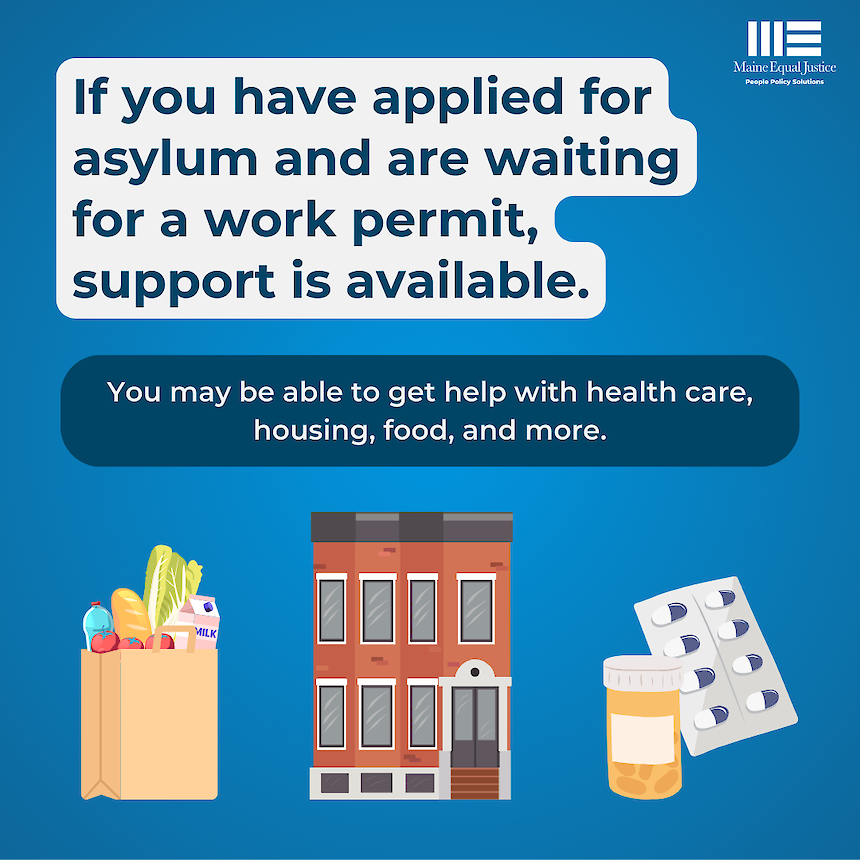
Depending on your income and immigration status you may be eligible for programs that help with health care, housing, food, and more. If your household includes any family member born in the United States that can make you eligible for some supports.
MaineCare is the state’s Medicaid program which provides free and low-cost health insurance to Mainers with low income to pay for health care. Some immigrants in Maine are eligible for MaineCare.
Note: People with qualifying income who are under the age of 21 or who are pregnant or postpartum can get full MaineCare benefits, regardless of their immigration status.
Starting October 1, 2026:
If you are not in one of the groups listed above you are not eligible for full MaineCare. You are only eligible for Emergency MaineCare.
Updated: August 2026
If you apply for MaineCare and would be eligible except for your immigration status, you will be enrolled in Emergency MaineCare.
Emergency MaineCare only pays for the health care services that are needed to treat a life-threatening health problem. Emergency MaineCare also pays for the cost of labor and delivery for childbirth but does not cover services provided outside the hospital.
If you have questions about what your MaineCare card pays for, call: MaineCare Member Services at 1-800-977-6740.
Updated: August 2026
Changes to MaineCare eligibility for some immigrants will begin on October 1, 2026. Unfortunately, only a small group of noncitizens will still be able to get full MaineCare coverage after this date.
Many people, like refugees, who have permission to stay in the U.S. and have long been eligible for MaineCare will lose their health insurance this fall. Maine’s Department of Health and Human Services (DHHS) estimates that more than 600 Maine households will lose MaineCare.
Who is losing full MaineCare eligibility?
Important reminder: people in these groups who are under 21 or pregnant can still apply for and keep their MaineCare.
Updated: August 2026
If you got a notice from DHHS saying that you are not eligible for MaineCare starting on October 1st, we recommend that you:
Immediately report any changes in your immigration status to DHHS (for example, if your green card was approved).
Continue to use your health care while you still have full MaineCare coverage, including getting primary and preventive care
Refill your prescriptions
Talk to your health care provider to discuss options for prioritizing necessary procedures or follow-up care before you lose MaineCare.
Find the nearest Community Health Center where you can get primary care or call Consumers for Affordable Health Care’s Helpline (1-800-965-7476) to help you understand your options for health care.
Updated: August 2026
Updated: August 2026
Hospital Free Care programs help Mainers pay for hospital bills and vary by facility. No one can be turned away from emergency services because of their immigration status or because they can’t afford to pay. If your income is under a certain level, medically necessary care must be provided for free. Request information about Free Care at any hospital in Maine.
MaineHealth Access to Care helps people in areas served by MaineHealth to apply for health coverage, afford medications and connect to community resources. Call 207-661-550 (or toll free 1-833-MHHELP1) or write to accesstocare@mainehealth.org.
Maine’s Community Health Centers provide primary care to anyone who needs it, regardless of their insurance status or ability to pay. To find the nearest Community Health Center visit: mepca.org.
The Consumers for Affordable Health Care (CAHC) Help Line (1-800-965-7476) connects you with a healthcare enrollment expert who helps you understand your options and enroll in Maine health coverage. The Help Line is free and confidential and available Monday through Friday from 8:30am – 4:00pm.
Updated: August 2026
Consumers for Affordable Health Care (CAHC): https://mainecahc.org/consumer-assistance/
Maine Department of Health and Human Services (DHHS): https://www.maine.gov/dhhs/ofi/programs-services/health-care-assistance
Updated: August 2026
States have always been required to share certain data with the Centers for Medicaid and Medicare Services (CMS), the federal agency that oversees Medicaid (MaineCare). This data includes information like names, addresses, phone numbers, Social Security numbers, date of birth, race/ethnicity, Medicaid coverage category, and citizenship status.
In the past, CMS did NOT share data with the Department of Homeland Security (DHS), which enforces immigration laws. However, a new data sharing agreement between CMS and DHS allows for some Medicaid data from people who are not lawfully residing in the U.S. to be shared with Immigration and Customs Enforcement (ICE). Some data still cannot lawfully be shared, including information about: U.S. citizens, people who are lawfully residing in the U.S., or sensitive medical records.
Families need to weigh getting health care coverage against the possible risk that their information may now be shared for other purposes, including immigration enforcement.
Do you already have MaineCare?
If you already have MaineCare and have not moved, there is no reason to withdraw or stop using those benefits at this point. Withdrawing will not erase your data from CMS’ records or impact your immigration case.
Are you thinking of applying for MaineCare?
If your identity and location are not already known by the federal government and someone in your family needs assistance, the risk of applying may be different. If you have concerns about your immigration status and the impacts, please contact an immigration attorney.
Are you in a “mixed status” household?
Only people who are applying for MaineCare need to share their immigration status. When completing an application for MaineCare, or other benefits like TANF and SNAP, you are not required to provide the Social Security Number or immigration status of family members who are not seeking benefits for themselves, and you should not include that information.
For example, if a parent is applying for MaineCare for their child but not for themselves, the parent’s immigration status is not needed for the application. However, if the parent or ineligible household member is also applying for Emergency MaineCare, they do need to verify their immigration status with DHHS.
Have you applied for immigration relief?
If DHS is already aware of your presence in the U.S. and has your address (such as from an immigration-related process or application), there may not be an additional risk to applying for or receiving public benefits like MaineCare.
What if I don’t qualify for full MaineCare?
Emergency MaineCare helps hospitals pay for emergency medical care for people who do not qualify for full-scope MaineCare due to their immigration status. This includes foreign students, temporary visa holders, asylum seekers, green card holders subject to the five-year bar, and people who are not lawfully present in the U.S. Information shared with the federal government does include the fact that someone is only eligible for Emergency MaineCare, but does not include a person’s exact immigration status.
You do not need to disclose your immigration status on an Emergency MaineCare application. You have the right to decline to apply for Emergency Medicaid and still get treatment, but you may receive bills for any medical care they receive without coverage.
Only you can decide what’s best for you and your family when it comes to sharing your information with the government.
Remember: Maine DHHS does not make house calls unannounced. If you need to get in touch with DHHS about your MaineCare, call 1-855-797-4357.
Updated: March 2026
The Supplemental Nutrition Assistance Program (SNAP), also called Food Assistance or Food Stamps, helps people pay for food.
Maine DHHS uses your household size, income, certain expenses, and immigration status to decide if you’re eligible for SNAP and the amount of monthly benefits you get.
You get a card that works like a debit card from a bank. You can use the card to buy food at grocery stores. The card is called the Pine Tree Card or an EBT card.
Updated: May 2026
Many non-citizens who have low income are able to get SNAP, but there are different federal and state rules, depending on your immigration status.
A. These groups are eligible for federal SNAP:
B. These groups must ALSO have a hardship* (see below) in order to get state SNAP
People who are undocumented or who do not have permission to remain in the U.S. are not eligible for SNAP. However, if you have children born in the United States, they may qualify for assistance even if you are not eligible based on your immigration status.
Updated: May 2026
If you have an immigration status listed in part B above, you have to meet all SNAP program requirements and have a hardship in order to qualify for state SNAP.
A hardship is defined in state law as at least one of the following:
As soon as you no longer meet one of these definitions, you have to report the change to DHHS and your benefits will end.
Updated: May 2026
In Maine, we have a state-funded SNAP program to support some immigrants who don’t qualify for federal support but meet all the other program requirements. State SNAP benefits work just like federal benefits and can be used anywhere SNAP is accepted. You apply the exact same way, and Maine’s DHHS decides which benefit you’re eligible for.
Remember: to qualify for state SNAP you also need to meet a “hardship exception” (see above) and once you begin working, you will lose your state-funded benefits, even if your income is still low enough to otherwise qualify.
Updated: May 2026
In households where people have different immigration statuses, some people may qualify for SNAP and others may not. Only those who will receive SNAP benefits need to share their immigration status, but all members of the household must be included on the application so DHHS can determine the household size and benefit level.
For example: If a family of four has one parent with a pending application for asylum, one parent who is undocumented, and two U.S. citizen children, the children may be eligible for Federal SNAP, the parent seeking asylum may be eligible for State SNAP, and the parent who is undocumented isn’t eligible for either program but would still be listed on the application. Only the parent seeking asylum and their U.S.-born children need to verify their immigration status with DHHS.
Updated: May 2026
Updated: May 2026
SNAP basics: You can learn more about SNAP benefits and other resources on our Food Assistance page.
SNAP benefit estimator: You can check if you're eligible for SNAP and estimate your monthly benefit with Pine Tree Legal Assistance's estimator.
Updated: May 2026
If you’re not eligible for a Social Security Number (SSN), you will need an Individual Taxpayer Identification Number (ITIN) and you will file taxes a little differently.
Most people in the United States need to file taxes, no matter their immigration status. You can see if you must pay taxes by checking with the Internal Revenue Service here.
Updated: February 2026
An Individual Taxpayer Identification Number, or ITIN, is a 9-digit tax processing number issued by the IRS as an alternative to a Social Security number. Having an ITIN can provide many benefits, including access to tax benefits.
Applying for an ITIN generally involves two steps:
Filing a U.S. federal tax return AND
Submitting a Form W-7 and providing required documentation to confirm both your identity and foreign status.
Applying through a Certified Acceptance Agent in Maine means you will not have to mail your original personal documents to the IRS for verification.
Updated: February 2026
In the past, the IRS has kept all tax information private by law, and would never share information about a tax filer’s immigration status or personal information with other agencies. This confidentiality played a critical role in ensuring that immigrants could file taxes without fear of immigration enforcement.
However, the Trump Administration is making unlawful attempts to access confidential personal information. This includes changing the long-established ban on data sharing between the IRS and the Department of Homeland Security and Immigration and Customs Enforcement (ICE). As a result, there are new potential risks involved in applying for an ITIN. Maine Equal Justice will continue following rulemaking and litigation on these issues and share updates as information changes.
The risk of DHS accessing your information is based on many individual factors, including your immigration status and the information already known by the government. If the federal government already has your name, address, and immigration status (for example, if you have a pending application for immigration relief), there is likely little additional risk in applying for an ITIN or filing your taxes.
If you have any questions about your immigration status, personal information, and taxes, you should seek specialized counsel from an immigration attorney.
For more information about data privacy and filing taxes as an immigrant, check out the National Immigration Law Center's resources.
Updated: February 2026
Here are some of the Maine refundable tax credits (meaning you get the money back even if you don’t owe any taxes) you may be eligible for when you file state taxes with an ITIN, especially if you have low or moderate income:
State Earned Income Tax Credit (EITC) – a Maine credit for working families with low to moderate incomes
Maine Dependent Exemption Tax Credit – a Maine credit for families with children/ dependents
Property Tax Fairness Credit (PTFC) – a Maine credit for renters and homeowners
Sales Tax Fairness Credit (STFC) – A Maine credit for people with low income to offset Maine’s sales and use tax
Updated: February 2026
Get free, local tax help from CA$H Maine. Find your local CA$H site here. For help in Portland, visit https://www.cashmaine.org/coalition/greater-portland/#locations or reach out to cash@uwsme.org.
Updated: February 2026
The National Immigration Law Center has great resources including:
FAQ: Individual Taxpayer Identification Number (ITIN): A Powerful Tool for Immigrant Taxpayers
Data Privacy and Federal Taxes for Immigrant Taxpayers
Updated: February 2026
This information comes from Protecting Immigrant Families (PIF) and they have great printable one-pagers of this information in English, Arabic, Spanish, French, Haitian Creole, Vietnamese, Korean, Chinese, and Tagalog.
Public charge is a rule in US immigration law where a person can be denied a green card, visa, or admission to the US based on usage or "likely usage" of public benefits. The specific rules of public charge often change with new presidential administrations.
Public charge can be used (and is currently being used) as a way to scare families away from using public benefits that they are eligible for.
By law, immigration officers must look at your whole life situation to decide if you can get a green card. They look at your age, your health, and your family. They also check your income, education, and work skills. Part of this check includes whether a family member or someone else has promised to support you financially.
The public charge test looks at whether you are likely to depend on the government at any time. The policy that took effect on September 18, 2026 says officers can look at any type of benefits you have used that are limited to people with low incomes – but having received a benefit does not automatically make you ineligible for Lawful Permanent Residency. The policy does not include a list of programs considered and allows officials to use their own judgment. Some “earned” benefits, like Medicare, Social Security, and unemployment insurance, are not counted.
Because these rules are complicated, it is a good idea to talk to a lawyer before you leave the country or apply for your green card.
This is not legal advice - every family’s situation is different. Speak to a knowledgeable immigration attorney before submitting any immigration-related application.
People with a humanitarian status who apply for green cards do NOT need to worry about public charge. This includes refugees, asylees, asylum seekers and T/U visa holders. Many immigrants we work with are exempt!
Public charge does NOT APPLY to you if:
Public charge MAY APPLY apply to you if:
We have a blog post that answers some common questions about the new policy:
Blog: Does public charge apply to me?
Updated: Sept 2026
Maine Equal Justice is not an immigration law firm, and this information should only be used for educational purposes. It is not meant to be formal legal advice regarding your particular immigration case. If you need advice about how the public charge rule might impact your immigration case, you should consult an immigration attorney, who may work with MEJ regarding the specifics of this rule.
The Immigrant Legal Advocacy Project (ILAP) in Maine has trusted immigration resources on applying for asylum, immigration court, Temporary Protected Status (TPS), checking in with ICE, and more. You can also contact ILAP to request free legal help.
English | Français | Español | Português | lingála | Kreyòl | Soomaali | العربية | Amjaric | Pashto | Dari
Updated: May 2026
Beware of people who try to take advantage of immigrants by pretending to help with immigration cases. These people can steal your money and hurt your immigration case. ILAP (Immigrant Legal Advocacy Project) has information:
English | Français | Español | Português | Kinyarwanda | Kreyòl | Soomaali | Pashto | Dari
Updated: May 2026
Address: 126 Sewall Street, Augusta, ME 04330
Phone: (866) 626-7059 (toll-free)
EIN: 04-3346273
Proud member of MaineShare | Terms of Use | Privacy Policy | Donate Online